How to Train Your Neck’s deep neck flexors for Long-Term Headache Relief
In my pdf Beyond the Posture Myth, Phase 2 of our clinical roadmap is built around a single muscle family: the deep neck flexors in the front of the neck.
Quick Summary:
What are the deep neck flexors (DNF)? They are the stabilizing muscles (longus colli/capitis) that sit directly against the cervical spine deep in the front of the neck.
Why do they matter? When these muscles are weak, superficial muscles take over, leading to neck stiffness and tension headaches and cervicogenic headaches .
How do you train them? Through gentle, precision movements like the “Supine Chin Nod” and “Seated Chin Tuck.”
How to Loosen a Stiff Neck
When you think of neck muscles, you probably picture the big ones you see in the mirror—the ones that shrug your shoulders or pull your head forward. These are your “movers.”
But deeper inside, tucked right against your spine, is your neck’s inner core.
In Beyond the Posture Myth, Phase 2 of our clinical roadmap is built around strengthening this exact muscle family: your deep neck flexors.
In my 25 years of practice, I’ve found that for most people with chronic “desk neck” or recurring headaches, this inner core has essentially gone to sleep. When these deep flexors stop doing their job, your surface muscles are forced to work overtime. Imagine using a heavy-duty crane to do the job of a precision instrument—it’s inefficient, it’s exhausting, and it eventually leads to the “temple-throbbing” headaches we all want to avoid.
Let’s break down what these muscles actually do, look at what the scientific evidence shows, and detail exactly how to train them.
Why this muscle group?
Why this muscle group?
Your neck has an “inner core” and it is often asleep
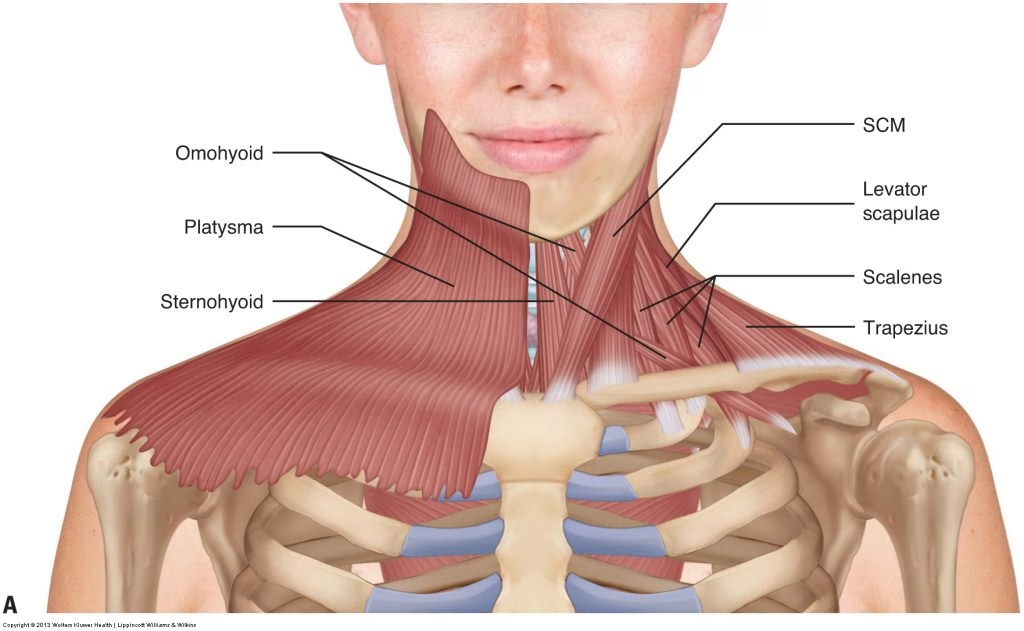
When you picture your neck muscles, you probably think of the ones you can see in the mirror. You think of the sternocleidomastoid running down the front, or the trapezius draping across your shoulders.
When you picture your neck muscles, you probably think of the ones you can see in the mirror. You think of the sternocleidomastoid running down the front, or the trapezius draping across your shoulders.
Those are your superficial movers. They are built for big, powerful actions.
Those are your superficial movers. They are built for big, powerful actions.
But tucked deeper inside, sitting directly against the front of your cervical spine, is a second layer. This group includes the longus colli, longus capitis, and the rectus capitis anterior and lateralis. Collectively, we call these the deep neck flexors (DNF).
Their job is not to generate large movements. Instead, they keep each neck vertebra steady and supported, segment by segment. It is a stabilizing role often compared to how the deep abdominal muscles support your low back.
Their job is not to generate large movements. Instead, they keep each neck vertebra steady and supported, segment by segment. It is a stabilizing role often compared to how the deep abdominal muscles support your low back.
While that comparison is a helpful mental picture, it is a bit of a simplification. The longus capitis and longus colli produce far less compressive force than your lower back’s core muscles, and researchers are still figuring out exactly how these small muscles manage segmental stability.
While that comparison is a helpful mental picture, it is a bit of a simplification. The longus capitis and longus colli produce far less compressive force than your lower back’s core muscles, and researchers are still figuring out exactly how these small muscles manage segmental stability.
But here is what we do know: when these deep flexors are weak or slow to activate, your superficial muscles are forced to take over the stabilizing job. Those superficial muscles were never built for continuous, low-level endurance. As they take on this extra work, they fatigue, tighten, and become a major source of neck stiffness and referred temple headaches.
This is the exact mechanism we highlighted in our main guide: sustained load on tissues that are not designed to handle it. Deep neck flexor training is how you rebuild the specific muscle endurance needed to share that load.
The Research
What the clinical evidence actually shows
Deep cervical flexor training is one of the most heavily researched exercises in physical rehabilitation. A few key findings highlight why it remains a clinical standard:
The Activation Patterns: A clinical trial by Jull, Falla, Vicenzino, and Hodges (2009) demonstrated that a structured program of craniocervical flexion training measurably increased the voluntary activation of the deep flexors in people with chronic neck pain.
Headache Relief: Van Ettekoven and Lucas (2006) ran a randomized trial adding craniocervical flexion training to physiotherapy for tension-type headaches. The group doing the deep flexor exercises got significantly better results than the group receiving standard physiotherapy alone.
Neuromuscular Control: A systematic review pooling multiple clinical trials (Blomgren et al., BMC Musculoskeletal Disorders, 2018) confirmed that deep cervical flexor training reliably improves motor control and muscle endurance in individuals with persistent neck pain.
Pain Reduction: A meta-analysis by Tsiringakis et al. (Musculoskeletal Science & Practice, 2020) found that biofeedback-based deep neck flexor training produced a measurable reduction in neck pain compared to general strength and endurance training.
A realistic clinical perspective
This is a highly effective, well-studied exercise, but it is not magic.
A comprehensive Cochrane review on exercise for mechanical neck disorders (Gross et al., 2015) found that several different exercise styles show clinical benefit, and no single movement reigns supreme.
Results vary from person to person. Deep neck flexor training works best as one piece of a larger puzzle: paired with joint mobility work and movement variability, rather than used as a standalone cure-all.
How It Is Assessed Clinically
The craniocervical flexion test (CCFT)
In the clinic, we check how well your deep neck flexors are firing using a protocol described by Jull, O’Leary, and Falla (2008).
You lie flat on your back with a small, uninflated pressure cuff tucked behind your neck. We pump the cuff up to a baseline of 20 mmHg.
From there, you perform a very gentle, subtle “yes” nod. This flexes your upper neck without lifting your head off the table. The goal is to nudge the pressure reading up through five distinct stages, from 22 mmHg up to 30 mmHg, holding each level steady for 10 seconds.
The movement is incredibly small. It is a tiny nod, not a large tuck.
Research by Falla, Jull, and Hodges (2004) showed that people with neck pain have noticeably reduced activity in their deep flexors during this test. Instead, they show immediate compensatory tension in the sternocleidomastoid and scalene muscles.
You do not need a pressure cuff to understand the coordination this test requires. The movement is all about precision and control.
The Target: A small nod at the very top of your neck (only a few degrees of motion).
The Mistake to Avoid: A chin-to-chest movement that flexes your entire neck.
Training at Home
No pressure cuff required
While a biofeedback cuff makes clinical testing precise, you can easily train this muscle group and build endurance at home.
Progress through these four levels in order. Spend your time on the level that challenges your control, and move forward only when you can perform it smoothly.
The Supine Chin Nod: Lie on your back with your knees bent. Gently nod your head as if making a tiny “yes” gesture. Do not lift your head. You should feel a very light, deep contraction in the front of your throat, not on the surface of your neck.
The Seated Chin Tuck: Sit tall and look straight ahead. Glide your head straight backward to create a slight double chin, keeping your eyes level. Use a mirror to make sure your nose stays horizontal and you are not tilting your head up or down.
The Held Endurance Nod: Lie on your back and perform the supine nod. Hold that light contraction for 10 full seconds. Keep your jaw relaxed and your breathing steady throughout the hold.
The Desk-Integrated Tuck: Once the movement feels natural, perform a gentle seated chin tuck a few times every hour at your desk. This acts as a perfect “movement snack” to break up static sitting.
Starting Parameters
Target: 10 repetitions
Hold Time: 10 seconds per rep
Sets: 1 to 3 sets
Frequency: Once or twice daily
These starting parameters are adapted from classic clinical training protocols. Focus on the quality of the movement. If your chin drifts or your jaw clenches, you have gone past your fatigue limit.
Most published clinical trials lasted six to seven weeks before showing structural changes in muscle endurance, so stay consistent before judging your results.
Common Mistakes to Avoid
Letting the surface muscles take over: If you see two thick cords pop out at the front of your neck, your sternocleidomastoid is doing the stabilizing work. Back off the depth of your nod until those surface muscles stay soft.
Nodding too far: Dropping your chin all the way toward your chest recruits your large, superficial muscles. Keep the movement small.
Holding your breath: Bracing or holding your breath means you are using raw effort instead of coordination. The contraction should be light enough that you can easily talk through it.
Where This Fits
Our 3-phase roadmap
Deep neck flexor training does not work in isolation. It is the middle phase of our care plan for a reason.
- Phase 1: The Unlock (Chiropractic Care): First, we restore normal movement to restricted joints in your neck.
- Phase 2: The Stability (Deep Flexor Training): Next, we build the targeted muscle endurance to support those joints.
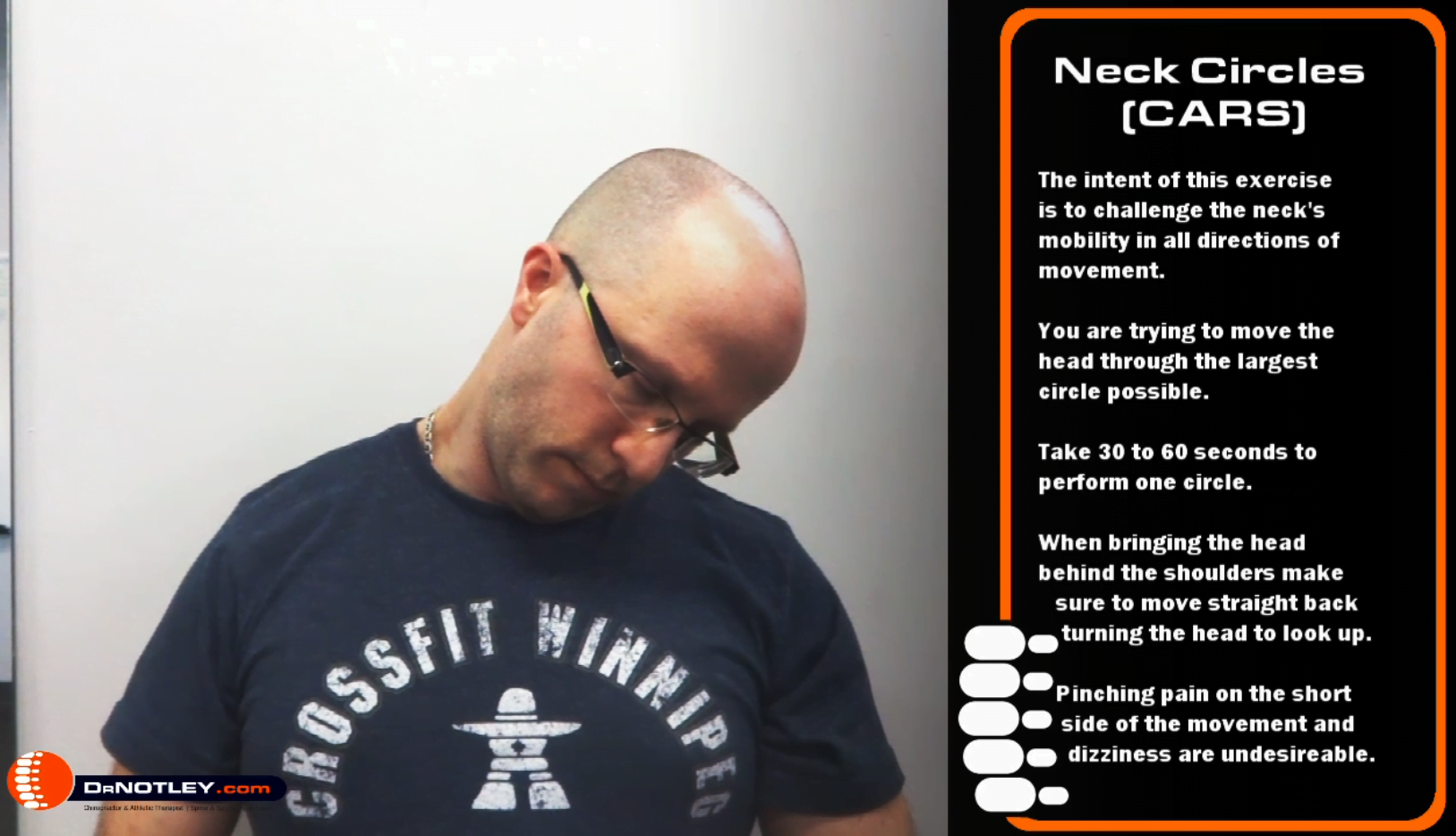
- Phase 3: The Variability (Movement Snacks & CARs): Finally, we integrate this control into varied daily movements, using tools like Controlled Articular Rotations (CARs) to keep your joints healthy.
Pairing deep neck flexor work with slow, controlled neck circles is an excellent way to maintain joint health.
Before You Start
A quick safety note
Deep neck flexor training should feel like light, coordinated muscle work. It should never cause pain.
Stop immediately and consult a professional if you experience sharp pain, dizziness, numbness, or tingling down your arms, or if the exercises consistently reproduce your headache.
Want your training built into a custom recovery plan?
Dr. Chris Notley has spent over 25 years helping Winnipeg professionals build physical capacity and overcome chronic neck pain and headaches.
Downtown Winnipeg Office: 164 Fort Street | Phone: 204-943-0751
St. Vital Office: 12-845 Dakota Street | Phone: 204-254-0130
Disclaimer: This article is for educational purposes only and is not a substitute for an individual medical assessment or diagnosis.
How do I train the deep flexor muscles of the neck?
The deep neck flexors (including the longus colli and longus capitis) act as the deep stabilizing system of your neck. You can train them using the craniocervical flexion movement, which starts with a gentle, small “yes” nod (chin-tuck) without lifting your head, holding for 10 seconds, and repeating for 10 repetitions.
References
- Jull GA, Falla D, Vicenzino B, Hodges PW. The effect of therapeutic exercise on activation of the deep cervical flexor muscles in people with chronic neck pain. Manual Therapy. 2009;14(6):696-701. https://pubmed.ncbi.nlm.nih.gov/19632880
- van Ettekoven H, Lucas C. Efficacy of physiotherapy including a craniocervical training programme for tension-type headache: a randomized clinical trial. Cephalalgia. 2006;26(8):983-991. https://pubmed.ncbi.nlm.nih.gov/16886935
- Jull GA, O’Leary SP, Falla DL. Clinical assessment of the deep cervical flexor muscles: the craniocervical flexion test. Journal of Manipulative and Physiological Therapeutics. 2008;31(7):525-533. https://pubmed.ncbi.nlm.nih.gov/18804003
- Falla DL, Jull GA, Hodges PW. Patients with neck pain demonstrate reduced electromyographic activity of the deep cervical flexor muscles during performance of the craniocervical flexion test. Spine. 2004;29(19):2108-2114. https://pubmed.ncbi.nlm.nih.gov/15454700
- Blomgren J, Strandell E, Jull G, Vikman I, Röijezon U. Effects of deep cervical flexor training on impaired physiological functions associated with chronic neck pain: a systematic review. BMC Musculoskeletal Disorders. 2018;19(1):415. https://pubmed.ncbi.nlm.nih.gov/30486819
- Tsiringakis G, Dimitriadis Z, Triantafylloy E, McLean S. Motor control training of deep neck flexors with pressure biofeedback improves pain and disability in patients with neck pain: a systematic review and meta-analysis. Musculoskeletal Science & Practice. 2020;50:102220. https://pubmed.ncbi.nlm.nih.gov/32827852
- Gross A, Kay TM, Paquin JP, et al. Exercises for mechanical neck disorders. Cochrane Database of Systematic Reviews. 2015;1:CD004250. https://pubmed.ncbi.nlm.nih.gov/25629215