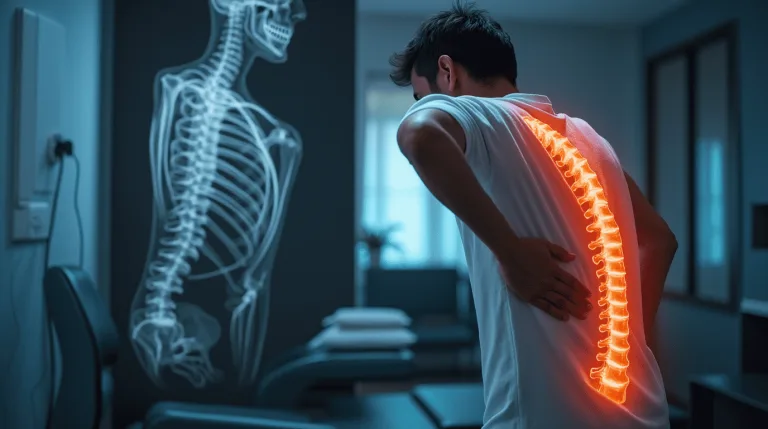
Disc Bulge vs. Extrusion vs. Herniation: What’s the Real Difference?
You get your MRI results back, and somewhere in the report is a word you were hoping not to see: bulge, protrusion, extrusion, or herniation. Maybe a friend said it “sounds serious,” or a quick Google search made things worse.
These terms get used loosely, and they aren’t interchangeable. Radiologists use them to describe how a disc looks on a scan, not how much pain you’re in or how well you’ll recover.
In this post, we’ll sort out the difference between a bulge, a protrusion, an extrusion, and a sequestration, and which of them count as true herniations. We’ll also cover the few red flags that mean “get seen today,” and why a big word on your report doesn’t have to mean a big problem. Along the way, you’ll see why your body is often better at clearing disc material than anyone tells you.
First, let’s deal with the fear that tends to show up the moment people read these words.
The fear
Discs don’t slip. Here’s the picture that replaces the myth.
“My disc slipped out of place and is permanently crushing my spinal cord.”
Think tire, not bar of soap. The outer wall can bulge, crack, or in some cases let a bit of the inner material push through, but the disc itself stays anchored in its spot between the bones.
A bit of history
The “Slipped Disc” Story: A Misleading Piece of History
The term “slipped disc” was coined decades ago, in a time when our understanding of spinal anatomy and pain was far less advanced. It was an attempt to simplify a complex injury for patients – a well-intentioned shorthand.
However, that simple phrase, while catchy, created a powerful and damaging image: a fragile spinal disc popping out of alignment like a bar of soap, ready to crush your nerves. This image, unfortunately, has stuck. It instills deep fear, makes people afraid to move, and can even slow down recovery because people believe their spine is inherently unstable and easily “breaks.”
Modern imaging and research have confirmed that this picture is anatomically incorrect. Your discs are incredibly tough, firmly anchored structures, not loose components that can “slip” out of place. Understanding this is often the first step in replacing fear with confidence in your spine’s resilience.
Decoding your report
Bulge, protrusion, extrusion, sequestration: what the words mean
These words describe how far the disc wall has moved. Tap each one to see what it looks like. They fall into two groups that often get lumped together by mistake.
Bulge Not a herniation
Key clue: broad and even
A broad, fairly even spreading of the disc wall outward, involving more than about a quarter of the disc’s circumference. It is the mildest and by far the most common finding, and, as covered in the main MRI Translation Guide, it shows up constantly in people with zero pain.
Radiologists don’t even count a bulge as a true herniation. If your report also says “desiccation,” that’s a separate age-related change, explained in What Is Disc Desiccation?
Protrusion Herniation
Key clue: base wider than reach
A focal outward push where the base is still wider than how far it extends.
Extrusion Herniation
Key clue: narrow neck, bigger piece
Material has pushed further out, and the neck connecting it back to the disc is now narrower than the piece that extruded.
Sequestration Herniation
Key clue: a fully separated fragment
A fragment has fully separated and migrated away from the disc.
Reads like a severity ladder, and in terms of appearance it is. The bars on each button show appearance on a scan only. Appearance and pain don’t move in lockstep, which is the part most patients are never told.
When severity does matter
Red flags Get seen today
In rare cases a disc problem can be dangerous. These are the specific signs that mean “get seen today” rather than “wait and see.”
- Severe pain after a clear trauma or injury
- Loss of bowel or bladder controlIncluding new trouble starting or stopping
- Significant new leg weaknessSuch as a foot that starts dragging or buckling
- Numbness across the saddle areaInner thighs, groin, or buttocks
- New or worsening weakness or numbness in both legs at once
- Fever with your back pain
These are uncommon. The vast majority of bulges, protrusions, extrusions, and even sequestrations never produce any of them. But if one does show up, it’s a same-day medical assessment, not something to sit with.
Everything below is about why the word on your report doesn’t predict how much pain you’ll have. It is not a substitute for these specific checks.
Why the word on your report doesn’t predict your pain
The size of a herniation doesn’t dictate your pain
Two things explain why a big herniation and a big pain problem don’t always show up together.
Pain is often more chemical than mechanical
Nerve roots become sensitized by inflammatory substances released from disc material, not just by physical pressure. Disc material placed against a nerve with no compression at all can still trigger pain, purely through inflammation.
Illustrations of the idea, not measurements. This is also why treatment that calms inflammation and reduces nervous system threat can improve symptoms well before the image changes.
Your body often clears herniated material itself
The inside of a disc is normally sealed off from your immune system. When a piece pushes out, your body sees it for the first time and treats it as material to clear away. Immune cells called macrophages move in and break it down. Try it below.
Day one: the extruded fragment is at its largest, and it has only just become visible to your immune system.
Disc material Macrophage (immune cell)
Illustration of the pattern seen in repeat-MRI studies, not a timeline for your disc. Larger extrusions and sequestrations often shrink the most, sometimes disappearing almost entirely. Small bulges and protrusions tend to change the least, because there’s less exposed material to clear.
What this means for you
Three things to take with you
A bigger word isn't a bigger problem
An "extrusion" on your report is not automatically a bigger problem for you personally than a "bulge."
Time and loading do real work
Time and appropriate loading are doing real work in the background, even when it doesn't feel like it week to week.
Pain can settle before the scan does
Pain calming down doesn't require the image to look "fixed" first. Nervous system sensitivity and inflammation typically settle before the scan does.
The goal isn't to stare at which word describes your disc. It's to build a plan that reduces irritation now and rebuilds capacity as things settle, regardless of which term is on the page.
Myth or fact?
Tap a card to flip it
Want help making sense of your own report?
Book an assessment with Winnipeg Chiropractor & Athletic Therapist Dr. Chris NotleyPart of our MRI Translation Guide series
More from the series
Sources and further reading (6)
- Fardon DF, Williams AL, Dohring EJ, et al. Lumbar Disc Nomenclature: Version 2.0. Spine. 2014. The standard radiology definitions of bulge, protrusion, extrusion, and sequestration, and why a bulge is not a herniation. Read on PubMed
- Deyo RA, Mirza SK. Herniated Lumbar Intervertebral Disk. N Engl J Med. 2016. Plain-language classification and the point that bulging and protrusion are common in people without pain. Read on PubMed
- Knezevic NN, et al. Low Back Pain. Lancet. 2021. Radicular pain from combined mechanical compression and chemical irritation. Read on PubMed
- Cunha C, et al. The inflammatory response in the regression of lumbar disc herniation. Arthritis Res Ther. 2018. Why larger and sequestrated herniations resorb more, and the immune mechanism behind it. Read the article
- Djuric N, et al. Lumbar disc extrusions reduce faster than bulging discs due to an active role of macrophages in sciatica. Acta Neurochir. 2020. Read the article
- Hennessy O, et al. Assessment and early investigation of cauda equina syndrome. Eur Spine J. 2025. The red-flag symptoms that require urgent imaging. Read on PubMed