Skip to content

Dr Notley Chiropractor and Athletic Therapist in Winnipeg

Self Myofascial Release of the Shoulder: Teres Major

    The teres major muscle is an important muscle that affects the shoulder and shoulder blade.  It originates near the inferior angle of the scapula (the bottom tip of the shoulder blade). It travels up through the armpit and attaches onto the humerus.  In the arm pit it runs right along side the latissimus dorsi muscle. Activities that use this muscle The teres major helps to adduct the arm, rotate the… Read More »Self Myofascial Release of the Shoulder: Teres Major
    Teacup dance: Shoulder Mobility Drill That Glides 3 Key Nerves

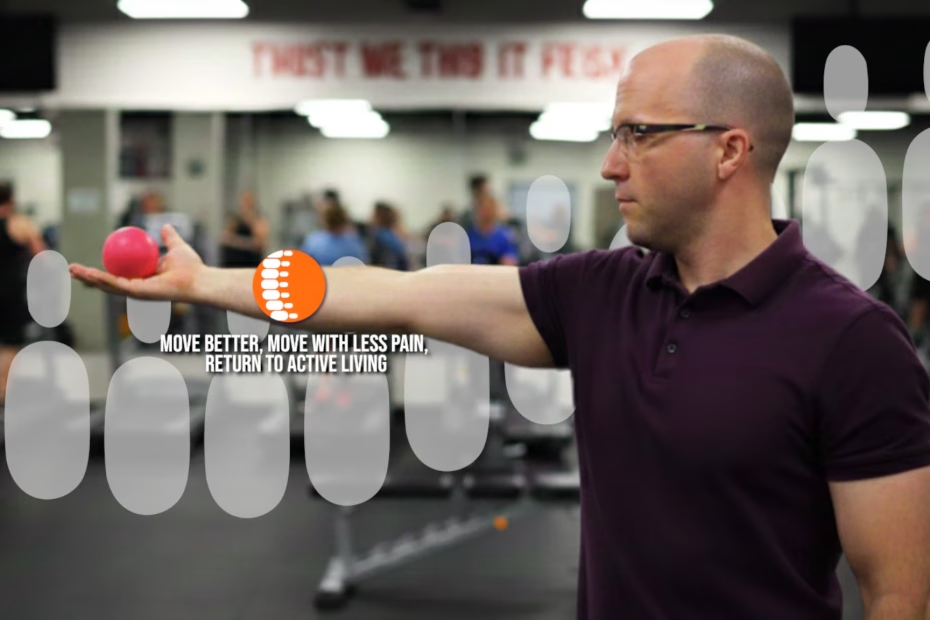
      Are your shoulders, elbows, or wrists feeling stiff or painful? Do you want a simple, flowing shoulder mobility drill that not only improves shoulder mobility but also gently encourages your nerves to move freely? The long-arm teacup drill might be exactly what you need. This smooth, figure-eight pattern looks like a simple shoulder mobility drill, but it’s much more than that. By guiding your arms through arcs and rotations, it… Read More »Teacup dance: Shoulder Mobility Drill That Glides 3 Key Nerves

      Quadruped Hip Circles (CARS)

        This is another one my exercises that I give to my athletes/patients in the controlled articular rotations (CARs) category. The training method and acronym is popularized by Dr Andreo Spina. It was taught to me at a Functional Range Conditioning course in Winnipeg.  I call them “circles” to my patients because it’s easier for them to understand.  What I like about CARs is that they are easy, yet challenging, and… Read More »Quadruped Hip Circles (CARS)

        Disc herniation versus Disc Bulge

          You just received your MRI results and it says that you have a disc herniation or disc bulge. I’m sure this might be worrisome to you. So what does this mean?  First of all, these terms are often used interchangeably but, in reality, there is a difference between the two. Anatomy of the disc The discs are spacers found between two vertebrae.  They are responsible for movement between the vertebrae;… Read More »Disc herniation versus Disc Bulge

          Self Myofascial Release of Levator Scapulae

            RKC Plank

            The levator scapulae begins on the side of the neck, travels down underneath the trapezius muscle and attaches onto the shoulder blade. It is often confused with a problem in the trapezius. It is a common cause of “stiff neck syndrome”   Actions When the neck is stabilized the muscle rotates the shoulder blade downwards and elevates the scapula. With the shoulder blade is fixed , this muscle assists rotation… Read More »Self Myofascial Release of Levator Scapulae

            the Half Kneeling Thoracic Rotation: Unlock Thoracic Mobility

              healthy spine

              Unlock Upper Back Mobility and Improve Spinal Health with the Half-Kneeling Thoracic Rotation The half-kneeling thoracic rotation is an effective exercise for improving thoracic spine mobility. It challenges stability, flexibility, and coordination, making it a valuable addition to any mobility routine. In this blog, we’ll cover why this exercise is important, how to perform rotations to both the open and closed sides, and tips for maximizing its benefits. Why Is… Read More »the Half Kneeling Thoracic Rotation: Unlock Thoracic Mobility

              Comparing hamstring activity with three different kettlebell swings

                RKC Plank

                I found this paper, Hamstring Myoelectrical Activity During Three Different Kettlebell Swing Exercises.   The paper compared how 3 different swings, the hinge swing, the squat swing, and the double knee extension swing (used in those who train for kettlebell sport) affected the hamstring muscles. The 3 hamstring muscles were divided into 2 parts a medial part (semitendinosus and semimembranosus) and the lateral part (biceps femoris). What they found was that… Read More »Comparing hamstring activity with three different kettlebell swings

                Self Myofascial Release of the Shoulder: Deltoid

                  The deltoid muscle, capping the shoulder joint, is made up of three parts.  There is an anterior (front) part, lateral (middle) part and posterior (back) part.  It is used in all forms of movement of the shoulder Action of the deltoid The anterior deltoid flexes the shoulder forward while the posterior deltoid extends the shoulder.  The middle portion abducts the arm out to the side; assisted by the other two portions.… Read More »Self Myofascial Release of the Shoulder: Deltoid

                  Review of a stand up desk converter

                    Movement is an important part of a healthy lifestyle.  Sadly, many of my low back pain patients are suffering with adisc injury because they sit for long periods of time. For these patients I often recommend they move more, get out of their seat more, going for walks, performing back bends, etc.  To keep them productive at work, I may suggest a stand up desk. For most companies and patients,… Read More »Review of a stand up desk converter