

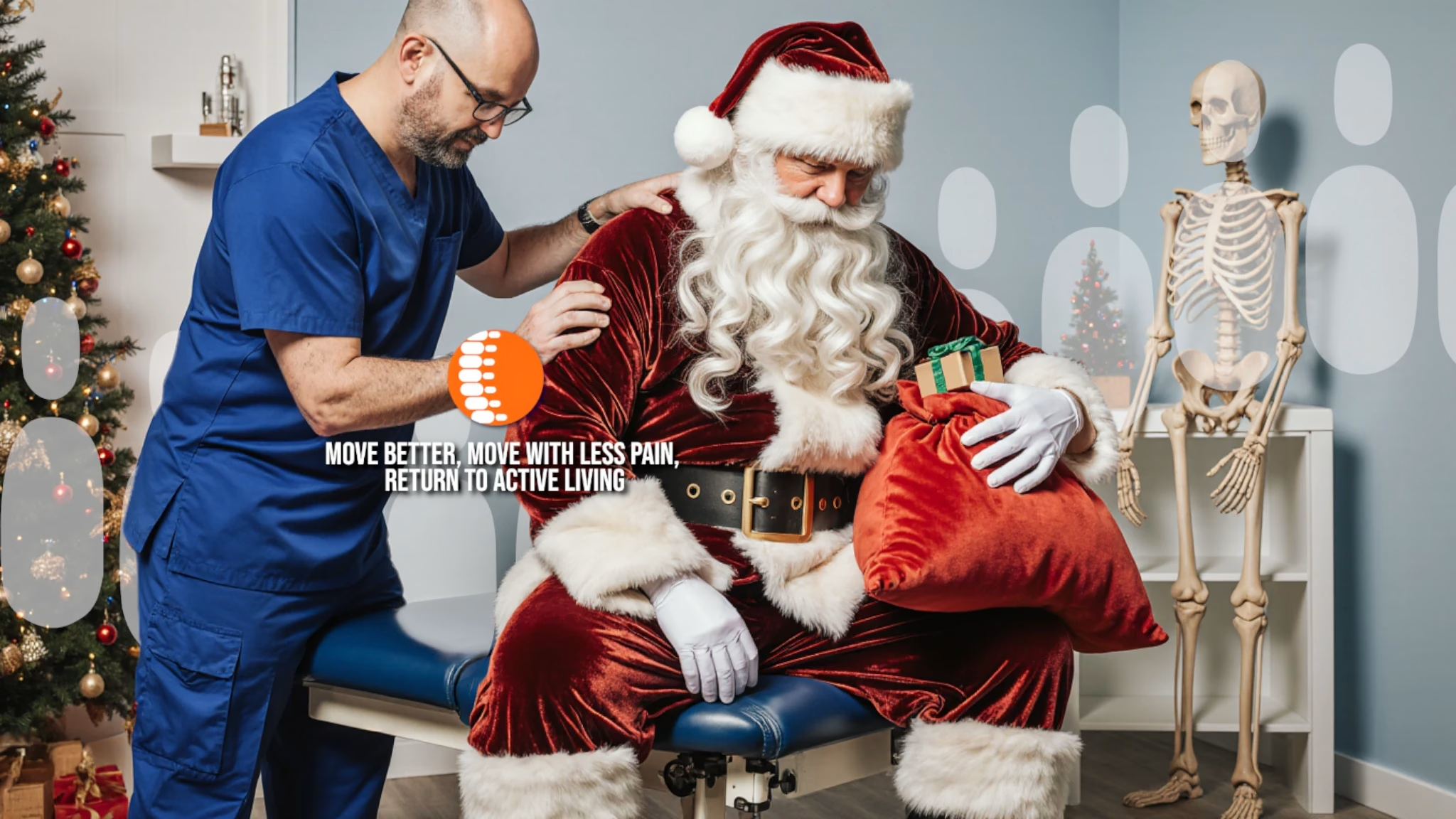
Would Santa Have Back Pain? Causes, Risk Factors, and Holiday Spine Health
Santa is usually portrayed as tireless. He lifts heavy loads, works long hours, travels the world in a single night, and never seems slowed down. But if Santa were a real person living under the same biological rules as everyone else, it raises an interesting and surprisingly practical question.
Would Santa have back pain?
From a clinical and research perspective, the answer is not only plausible. It is likely. Low back pain is not a rare or unusual condition. Research consistently shows that up to 80 percent of people will experience low back pain at least once in their lifetime. That statistic alone reframes the conversation. Back pain is not a sign of weakness, poor posture, or structural failure. It is a normal human experience that emerges when physical load, recovery, sleep, stress, and health behaviors drift out of balance.
Santa’s lifestyle happens to align closely with what the research tells us about how back pain actually develops.
Santa’s Workload and the Reality of Human Spines
Santa’s job is unique, but the pattern is familiar. For much of the year, his physical demands are relatively modest. He spends long hours sitting, planning, managing logistics, checking lists, and overseeing operations. Then, in a very short window, his physical workload spikes dramatically. On Christmas Eve he sits for prolonged periods, lifts heavy loads, carries them repeatedly, climbs, twists, and moves under time pressure, all while fatigued and sleep deprived.
Research on occupational and sports-related back pain shows that sudden increases in workload are one of the strongest predictors of low back pain. This is not because the spine is fragile. It is because tissues adapt gradually. When demand increases faster than capacity, even a healthy spine can become painful.
Santa’s situation closely resembles the weekend warrior phenomenon. People who are generally inactive but suddenly perform intense physical tasks are more likely to experience back pain than those who train consistently. The issue is not the activity itself. It is the lack of preparation and recovery.
Age, Disc Changes, Arthritis, and What Imaging Really Means
Santa is traditionally depicted as older, with a long white beard and decades, if not centuries, of experience. From a medical standpoint, this matters less than people think. With age, spinal changes are expected. Intervertebral discs lose water content, facet joints develop arthritic changes, and the spaces around nerves may narrow slightly. These findings are commonly labeled as degeneration or spinal stenosis on imaging.
What is often misunderstood is how little these findings explain pain. Large imaging studies consistently show that disc degeneration, disc bulges, arthritis, and even spinal narrowing are extremely common in people with no back pain at all. Disc degeneration is present in a significant percentage of pain-free adults in their twenties and becomes nearly universal by older age. Arthritis of the spine has often been described as grey hair of the spine. It is a normal biological process, not a diagnosis.
If Santa had an MRI, it would almost certainly show age-related changes. That would not tell us why he hurts. Imaging describes structure. Pain is influenced far more by how the spine is being loaded, how well it is recovering, and how sensitive the nervous system has become.
Sleep Deprivation and the Cost of All-Nighters
Sleep is one of the most underappreciated contributors to back pain, and Santa’s sleep schedule would be a major concern. In the weeks leading up to Christmas, he likely experiences shortened and disrupted sleep due to stress, planning, and responsibility. Chronic sleep restriction has been shown to increase pain sensitivity, reduce muscular endurance, impair coordination, and slow tissue recovery.
The Christmas Eve all-nighter compounds this problem. Acute sleep deprivation alters how the brain processes pain signals. The nervous system becomes more protective. Movements that are normally tolerated can feel uncomfortable or painful. Muscles fatigue more quickly, and reaction time slows. Lifting and carrying under these conditions increases the likelihood of back pain even without any tissue injury.
In this context, pain would be a predictable response, not a sign of damage.
Prolonged Sitting Followed by Heavy Lifting
Santa’s job also involves long periods of sitting followed by sudden physical effort. Research shows that spinal tissues adapt to the positions they stay in. Prolonged sitting increases spinal stiffness and alters load distribution. When heavy lifting follows immediately, spinal strain increases, especially if fatigue is present.
This pattern is well documented in occupations such as long-haul driving. The issue is not sitting itself, but the transition from prolonged sitting to demanding physical tasks without adequate movement preparation.
Uneven Lifting and Repetitive Carrying
Santa traditionally carries a heavy sack over one shoulder. Repetitive asymmetrical loading increases muscular fatigue and coordination demands. Over time, this can contribute to discomfort, particularly when combined with fatigue and time pressure.
Again, this does not mean lifting is dangerous or that Santa’s spine is vulnerable. It means that sustained imbalance reduces tolerance and increases the likelihood of pain when other stressors are present.
Stress, Responsibility, and Pain Sensitivity
Santa’s job is high responsibility with a fixed, non-negotiable deadline. Psychological stress does not damage spinal tissues, but it does influence pain. Stress increases muscle tone, heightens nervous system sensitivity, and reduces recovery efficiency. Pain is produced by the brain as a protective response, and stress lowers the threshold at which that response is triggered.
This is one reason why back pain often appears during high-pressure periods and improves when life demands settle.
Nutrition, Metabolic Health, and Back Pain
Nutrition influences back pain in ways that go beyond body weight. Diets high in refined sugars and ultra-processed foods are associated with increased systemic inflammation, insulin resistance, and impaired recovery. These metabolic factors have been linked to chronic low back pain in population studies.
Santa’s fondness for cookies and milk may be festive, but chronically high sugar intake would likely impair metabolic health over time. Poor metabolic health is associated with reduced tissue repair and altered pain processing. Studies have shown that metabolic syndrome is more common among people with chronic low back pain, even when weight alone is considered.
Intervertebral discs rely on diffusion for nutrition rather than direct blood supply. Anything that compromises vascular health or increases inflammation may reduce disc resilience. This does not cause immediate injury, but it lowers the spine’s tolerance to load.
Smoking History and Disc Health
Smoking is one of the most consistently reported lifestyle factors associated with low back pain. Nicotine reduces blood flow, impairs oxygen delivery, and interferes with disc cell metabolism. Over time, this accelerates disc degeneration and reduces repair capacity.
Even if Santa quit smoking years ago, past exposure still matters. While quitting improves overall health, established disc changes do not fully reverse. Smoking is also associated with increased pain sensitivity through nervous system mechanisms, meaning physical stress may be perceived as more painful.
Inactivity and Deconditioning
For much of the year, Santa’s job may not demand significant physical conditioning. Without regular movement variability, strength, and endurance, the spine becomes less tolerant to sudden load. Back pain often reflects a mismatch between what the body is conditioned for and what it is suddenly asked to do.
This is not a flaw. It is how human biology works.
So Would Santa Have Back Pain?
Santa possesses many of the most well-established contributors to low back pain. He would fall within the same risk profile as most adults. Age-related spinal changes, sleep deprivation, stress, sudden workload spikes, prolonged sitting, uneven lifting, nutritional factors, and a possible smoking history all interact.
None of these mean his spine is broken. They explain why back pain is so common.
Most episodes of low back pain improve with time, movement, and restored recovery. The spine is strong, adaptable, and resilient, even after a long night of delivering presents.
What If You’re Dealing With Back Pain Right Now?
If any of this sounds familiar, you’re not alone. Most back pain is not caused by damage, and most people improve when the right factors are addressed. That starts with understanding what is contributing to your pain and what is not.
If your back pain is limiting your movement, your sleep, or your confidence in your body, getting a proper assessment matters. A good assessment looks beyond imaging and focuses on how your spine is moving, how it tolerates load, how your nervous system is responding, and how your lifestyle factors fit together.
If you’re in Winnipeg and want help making sense of your back pain, I work with people every day who feel stuck, worried, or unsure what to do next. The goal is not quick fixes or fear-based explanations. The goal is to help you move better, understand your pain, and regain trust in your body.
Back pain is common. Living limited by it doesn’t have to be.
Frequently Asked Questions About Back Pain
Is back pain normal?
Yes. Low back pain is extremely common, with up to 80 percent of people experiencing it at least once in their lifetime.
Do disc bulges, arthritis, or degeneration always cause pain?
No. These findings are common in people without pain and increase with age. Imaging findings do not reliably predict symptoms.
Can poor sleep make back pain worse?
Yes. Sleep deprivation increases pain sensitivity, reduces recovery, and makes physical stress feel more painful.
Does stress contribute to back pain?
Yes. Stress increases nervous system sensitivity and muscle tension, which can amplify pain without tissue injury.
Does smoking or poor nutrition affect back pain?
Yes. Smoking and poor metabolic health are associated with disc degeneration, chronic pain, and reduced recovery capacity.
References
Hartvigsen, J., Hancock, M. J., Kongsted, A., Louw, Q., Ferreira, M. L., Genevay, S., … Woolf, A. (2018). What low back pain is and why we need to pay attention. The Lancet, 391(10137), 2356–2367.
https://doi.org/10.1016/S0140-6736(18)30480-X
Hoy, D., Bain, C., Williams, G., March, L., Brooks, P., Blyth, F., … Buchbinder, R. (2012). A systematic review of the global prevalence of low back pain. Arthritis & Rheumatism, 64(6), 2028–2037.
https://doi.org/10.1002/art.34347
Brinjikji, W., Luetmer, P. H., Comstock, B., Bresnahan, B. W., Chen, L. E., Deyo, R. A., … Jarvik, J. G. (2015). Systematic literature review of imaging features of spinal degeneration in asymptomatic populations. American Journal of Neuroradiology, 36(4), 811–816.
https://doi.org/10.3174/ajnr.A4173
Jensen, M. C., Brant-Zawadzki, M. N., Obuchowski, N., Modic, M. T., Malkasian, D., & Ross, J. S. (1994). Magnetic resonance imaging of the lumbar spine in people without back pain. New England Journal of Medicine, 331(2), 69–73.
https://doi.org/10.1056/NEJM199407143310201
Deyo, R. A., & Weinstein, J. N. (2001). Low back pain. New England Journal of Medicine, 344(5), 363–370.
https://doi.org/10.1056/NEJM200102013440508
Finan, P. H., Goodin, B. R., & Smith, M. T. (2013). The association of sleep and pain: An update and a path forward. The Journal of Pain, 14(12), 1539–1552.
https://doi.org/10.1016/j.jpain.2013.08.007
Alsaadi, S. M., McAuley, J. H., Hush, J. M., Maher, C. G., & Grunstein, R. R. (2011). The bidirectional relationship between pain intensity and sleep disturbance in patients with low back pain. Pain, 152(7), 1631–1637.
https://doi.org/10.1016/j.pain.2011.02.043
Shiri, R., Karppinen, J., Leino-Arjas, P., Solovieva, S., & Viikari-Juntura, E. (2010). The association between smoking and low back pain: A meta-analysis. The American Journal of Medicine, 123(1), 87.e7–87.e35.
https://doi.org/10.1016/j.amjmed.2009.05.028
Shiri, R., Solovieva, S., Husgafvel-Pursiainen, K., Telama, R., Yang, X., Viikari, J., … Raitakari, O. T. (2013). The role of obesity and physical activity in non-specific and radiating low back pain: The Young Finns study. Seminars in Arthritis and Rheumatism, 42(6), 640–650.
https://doi.org/10.1016/j.semarthrit.2012.09.002
van Tulder, M., Becker, A., Bekkering, T., Breen, A., del Real, M. T., Hutchinson, A., … COST B13 Working Group on Guidelines for the Management of Acute Low Back Pain in Primary Care. (2006). Chapter 3. European guidelines for the management of acute nonspecific low back pain in primary care. European Spine Journal, 15(Suppl 2), S169–S191.
https://doi.org/10.1007/s00586-006-1071-2
Originally posted on May 17, 2022 @ 4:39 pm