Skip to content

Exercises

Circles (CARs) for healthy elbows

    To keep our joints healthy we need to move them, on a daily basis, throughout their full range of motion. This helps stress the ligaments and muscles supporting the joints, as well as, distribute the synovial fluid throughout the joint. The synovial fluid helps to reduce friction and provide the cartilage with the nutrients it needs to stay healthy. Elbow circles (CARS) This is another one of my exercises that… Read More »Circles (CARs) for healthy elbows

    Knee circles for healthier knees

      Dr Notley, Winnipeg Chiropractor and athletic therapist, demonstrates open chain knee circles to emphasis the rotational mobility of the knee. The knee has the ability to rotate. A lack of range of motion in rotation can alter the movements around the ankle and hip. This may be a cause of pain in the knee, ankles, hips and even the lower back.  Those who have pain with squatting may be having… Read More »Knee circles for healthier knees

      TRX suspension trainer and back pain: challenging the spine

        This is a continuation of my previous blog post, Core Training: Back Pain Rehabilitation and Rowing Exercise.  If you don’t feel like reading the previous post, the research paper compared the load on the spine between three rowing exercises (inverted row, one arm standing row, and bent over row). The inverted row had the lowest load on the spine. The one arm row had the highest torsional challenge (the core… Read More »TRX suspension trainer and back pain: challenging the spine

        Plank : new challenges

          RKC Plank

          My previous post on the plank exercise was on how to make the plank easier until you are ready to progress to the full plank. The plank is a great exercise that strengthens the anterior chain of the core muscles. It is also a great exercise to start strengthening the shoulders.  I often give this exercise to my chiropractic patients who have had a history or chronic lower back pain. … Read More »Plank : new challenges

          Recent Back Injury? Core exercises to minimize spinal load

            If you’re recovering from a recent back injury or are just starting core training, it’s important to choose exercises that not only strengthen your core but also minimize the risk of re-injury. In this post, I’ll break down some of the best core exercises for those in the subacute phase of recovery, and why they are effective, based on the latest biomechanics research. Awhile back I attended a seminar by… Read More »Recent Back Injury? Core exercises to minimize spinal load

            Neck Circles (CARs) for neck mobility

              This is another one of my exercises that I give to athletes/patients in the controlled articular rotations (CARs) category. The training method and acronym is popularized by Dr Andreo Spina. It was taught to me at a Functional Range Conditioning course in Winnipeg.  I call them “circles” to my patients because it’s easier for them to understand.  What I like about CARs is that they are easy, yet challenging, and… Read More »Neck Circles (CARs) for neck mobility

              5 Evidence-informed Reasons Multifidus Training may be the Missing Link in Back Rehab

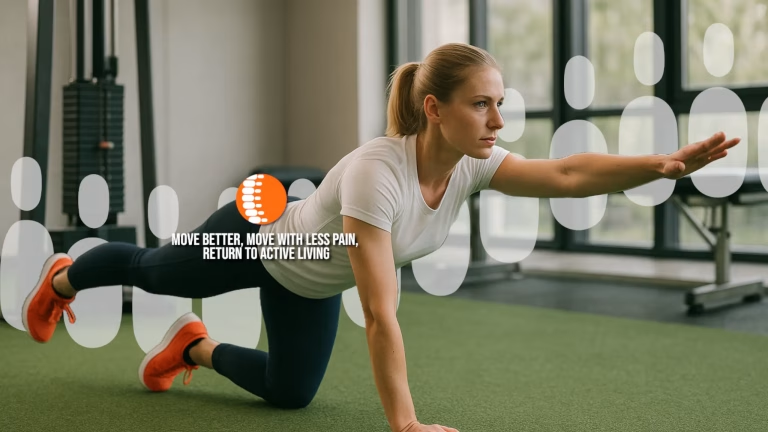
                Winnipeg chiropractor bird dog exercise for multifidus training

                We load squats and deadlifts for core strength, but multifidus training plays by different rules. After a back injury, many people return to lifting once pain fades. It makes sense—rebuild strength, regain stability. But research shows that one key spinal muscle, the lumbar multifidus, doesn’t always recover on its own. The multifidus is a deep stabilizing muscle that helps control small spinal movements. When back pain strikes, it can weaken… Read More »5 Evidence-informed Reasons Multifidus Training may be the Missing Link in Back Rehab

                Self Myofascial Release of the Shoulder: Teres Major

                  The teres major muscle is an important muscle that affects the shoulder and shoulder blade.  It originates near the inferior angle of the scapula (the bottom tip of the shoulder blade). It travels up through the armpit and attaches onto the humerus.  In the arm pit it runs right along side the latissimus dorsi muscle. Activities that use this muscle The teres major helps to adduct the arm, rotate the… Read More »Self Myofascial Release of the Shoulder: Teres Major