Solving the Headache Puzzle: New Evidence for Winnipeg Residents
Are your headaches coming from your neck or stress? New 2024 guidelines clarify how to treat the two most common types without relying solely on medication.

New research suggests your “neck headache” needs more than just a quick fix. The 2026 chiropractic guidelines show that while adjustments are key, the real secret to lasting Cervicogenic Headache Relief in Winnipeg is a multimodal plan that targets both joint and soft tissue.
If you’ve spent your morning commute white-knuckling the steering wheel on Pembina Highway, you know the feeling: a dull ache creeping from the base of your skull toward your temple. Many of our patients at the clinic try to push through this, assuming it’s just “posture” or stress. However, if that ache is actually a cervicogenic headache, the way we manage it determines whether you get a few hours of relief or a long-term solution.
This post synthesizes the 2026 Clinical Practice Guideline for the chiropractic management of headaches for our patients in Winnipeg. Whether you visit us at our Carlton Street clinic (serving Osborne Village and the Exchange) or the St. Vital clinic, we want you to understand the shift in how we treat these conditions. The data reveals that a “one-size-fits-all” adjustment isn’t the best path—specific diagnosis is.
CURRENT UNDERSTANDING
For years, the standard advice for headaches has been a mix of “take an aspirin and rest” or a generic neck stretch. We often see patients who have been told to simply avoid anything that triggers the pain, leading to a protective “bracing” posture. While this feels logical—who wants to move when their head is pounding?—it often backfires.
By protecting the neck too much, the joints can become stiffer and the supporting muscles more sensitized. This creates a cycle where the very thing you do to avoid the headache actually makes the neck more prone to triggering one. The tension builds, the mobility drops, and suddenly a short drive down St. Mary’s Road feels like an athletic feat of endurance.
THE STUDY: CHANGING THE NARRATIVE
The Trager et al. (2026) guideline is a synthesis of high-level evidence designed to standardize how we help you. The research categorized patients into two main groups: those with Cervicogenic Headaches (CGH) — actually caused by neck structures —and Tension-Type Headaches (TTH).
While spinal manipulation is a powerhouse for CGH, it should rarely stand alone for tension headaches. The data suggests that for long-term TTH relief, a multimodal approach, combining adjustments with soft tissue work and exercise, is significantly more effective than “just an adjustment.”
We must note that this was a consensus guideline based on an umbrella review of existing studies. While it represents the strongest current agreement in the field, we treat these as high-level recommendations rather than absolute certainties for every individual case.
FINDING YOUR NECK’S UNIQUE SWEET SPOT
Diagnosis
The data recommends using the ICHD-3 criteria to confirm your headache is actually coming from the neck (CGH) before starting heavy treatment.
At the clinic: For patients working at desks in The Exchange District, we use the Flexion-Rotation Test to see if your top two neck vertebrae are truly the source of your pain.
Modality Mix
For Tension-Type Headaches, the research suggests SMT is most effective when paired with soft tissue therapy and joint mobilization.
At the clinic: Whether you play ultimate frisbee or are an office working with a tension headache we don’t just adjust; we integrate myofascial work to ensure your muscles aren’t fighting the new mobility we’ve created.
Physical Activity
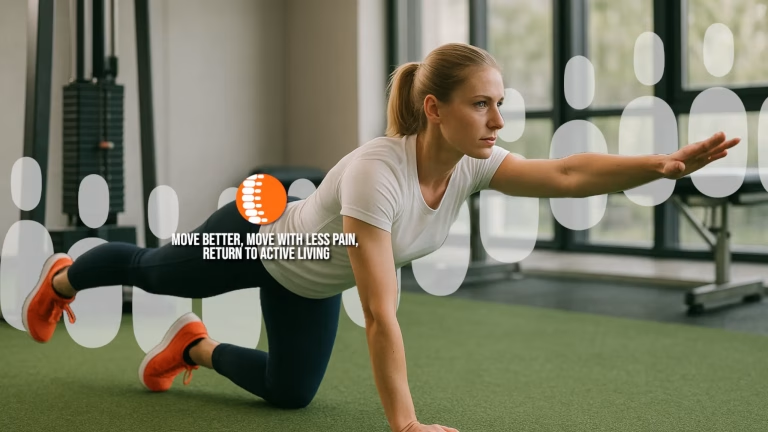
The guideline supports therapeutic exercise to maintain the gains made during your office visits.
At the clinic: We often prescribe “movement snacks” to prevent the static loading that triggers these headaches in the first place.
Personalized Headache Care
The science is clear: your care needs to be as specific as your symptoms. At Precision Movement and Therapies, near the Pyramid Cabaret, we see many professionals whose headaches are driven by screen time and static posture. Meanwhile, at our St. Vital location, we often help families and active adults manage headaches that interfere with their weekend routines.
Don’t let your headache hold you back
CONCLUSION
The 2026 headache guidelines confirm that specific, multimodal care is the most effective path forward. By moving away from generic rest and toward active, evidence-based loading and Don’t let your headache hold you back, we can change the trajectory of your recovery. We invite our patients to embrace movement over protection. We look forward to helping you get back to the activities you love in this community.
Frequently Asked Questions
Can my neck really cause my headache?
Yes. This is called a Cervicogenic Headache. The nerves in your upper neck are closely linked to the nerves that signal pain in your head. The new guidelines strongly recommend spinal manipulation for this specific type.
Is an adjustment enough for tension headaches?
The latest research says no. For tension-type headaches, the best results come from “multimodal care”—a mix of adjustments, muscle work, and specific exercises.