Best Lighting for Migraine Relief: Managing Light Sensitivity (Photophobia)
Can Light Trigger or Worsen Migraines?
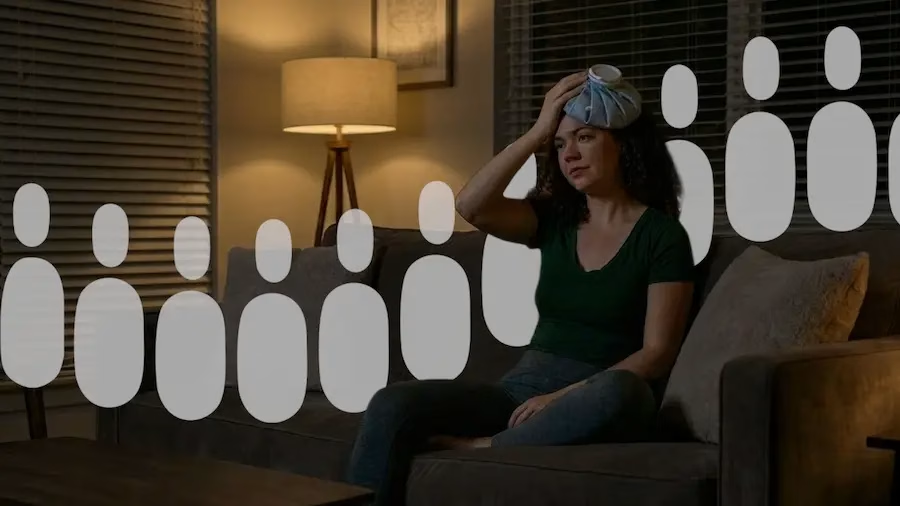
Yes—light can directly worsen migraine pain. This is known as photophobia, and it is one of the most common and disabling features of migraine.
This isn’t simply eye sensitivity. Research from groups including Rami Burstein shows that specific retinal pathways connect directly to brain regions involved in pain processing. As a result, light can amplify headache intensity—not just feel bright or uncomfortable.
Is Sitting in a Dark Room Good for Migraines?
It can help during an acute attack, but it’s not a good long-term strategy.
While reducing light exposure can temporarily decrease symptoms, chronic light avoidance may increase sensitivity over time. The nervous system can become more reactive when it is consistently underexposed to normal sensory input.
Current behavioral research suggests that, in many cases, a better approach is to maintain tolerable exposure and gradually improve tolerance, rather than relying on strict avoidance.
What Type of Light Is Best for Migraine?
The type of light matters as much as the brightness.
Research indicates that:
- Blue-rich light (common in screens and “daylight” LEDs) is more likely to aggravate symptoms
- Narrow-band green light appears to be better tolerated and may reduce pain in some individuals
Studies published in Cephalalgia and related journals suggest that modifying the spectral composition of light, by reducing blue and cyan, can influence symptom severity. However, these findings come from relatively small and controlled studies, and responses vary between individuals.
In practice, many patients find warmer indoor lighting and reduced glare easier to tolerate.
Do Blue Light Glasses or Tinted Lenses Help Migraines?
They can be helpful for some patients.
Precision-tinted lenses (such as FL-41) are designed to filter wavelengths associated with migraine discomfort. Clinical studies suggest they may reduce light sensitivity and improve comfort in certain environments.
That said, they are not universally effective and should be viewed as one tool among several, rather than a standalone treatment.
Where Musculoskeletal (MSK) Care Fits In
Migraine is influenced by multiple systems, including the musculoskeletal system.
The upper cervical spine shares neural connections with trigeminal pathways in the brainstem. This helps explain why cervical dysfunction can contribute to overall migraine burden and reduce tolerance to common triggers such as posture, screen exposure, and sustained loading.
However, it’s important to be precise:
MSK treatment does not directly treat photophobia.
What current evidence supports is a multimodal approach to migraine management. While no single intervention consistently resolves light sensitivity, combining strategies that reduce overall symptom load—such as optimizing lighting, maintaining exposure tolerance, and addressing relevant musculoskeletal contributors—may improve how patients tolerate triggers.
In this context, MSK care is best understood as helping to reduce background nociceptive input and improve overall tolerance, rather than targeting light sensitivity in isolation.
How to Reduce Light Sensitivity in Migraine
A practical approach focuses on both environment and overall system load.
Start by modifying lighting conditions—using warmer bulbs, reducing glare, and avoiding overly harsh “daylight” LEDs indoors. At the same time, avoid prolonged periods in complete darkness outside of acute attacks. Maintaining consistent, tolerable exposure is more likely to preserve normal sensitivity.
For patients with posture-related aggravation, prolonged sitting, or neck discomfort, addressing these contributors may further reduce overall reactivity and improve day-to-day tolerance.
The goal is not to eliminate all triggers, but to increase your capacity to function despite them.
Key Takeaway
The best lighting for migraine isn’t the darkest—it’s the most tolerable.
Current evidence supports:
- Adjusting light quality rather than simply reducing brightness
- Avoiding long-term over-restriction of sensory input
- Using a multimodal strategy to reduce overall symptom burden
This approach is more consistent with modern migraine science and more sustainable for daily life.
Frequently Asked Questions About Migraine and Light Sensitivity
Why do lights trigger migraines in Winnipeg winters?
Lights can trigger migraines due to photophobia, which is an increased sensitivity in how the brain processes visual input. In Winnipeg winters, reduced natural daylight often leads to increased exposure to artificial lighting and screens, which may worsen symptoms in some individuals.
What lighting is best for migraines at home or the office?
Warm, low-glare lighting with reduced blue wavelengths is generally better tolerated. Harsh LED lighting and bright, high-glare environments are more likely to trigger migraine symptoms, especially with prolonged exposure.
Is it bad to sit in a dark room during a migraine?
Dark rooms can help during an acute migraine attack, but frequent or prolonged light avoidance may increase sensitivity over time. Gradually maintaining exposure to tolerable light levels is generally more effective for long-term management.
Do blue light glasses actually help migraines?
Blue light filtering lenses, including precision-tinted options such as FL-41, may reduce light sensitivity and improve comfort for some people. However, results vary, and they are best used as part of a broader migraine management approach rather than a standalone treatment
Can neck pain trigger migraines and light sensitivity?
Neck dysfunction does not directly cause migraine light sensitivity, but it may contribute to overall migraine burden. The upper cervical spine shares neural connections with trigeminal pain pathways, so musculoskeletal factors can influence symptom severity in some individuals.
Who treats migraine light sensitivity in Winnipeg?
Migraine light sensitivity is typically managed by healthcare providers experienced in headache disorders. Care may include a combination of environmental modification, medical management, and musculoskeletal assessment depending on the patient’s presentation.
References
- Rami Burstein et al.
Light-induced exacerbation of migraine headache via retinal pathways
Nature Neuroscience (2010)
https://www.nature.com/articles/nn.2687 - Noseda R, Burstein R.
Advances in understanding the mechanisms of migraine-type photophobia
Current Opinion in Neurology (2011)
https://journals.lww.com/co-neurology/Abstract/2011/06000/Advances_in_understanding_the_mechanisms_of.11.aspx - Noseda R et al.
A neural mechanism for exacerbation of headache by light
Nature Neuroscience (2010)
https://www.nature.com/articles/nn.2591 - Martin VT et al.
Behavioral management of migraine: avoiding triggers vs coping with triggers
Current Pain and Headache Reports (2014)
https://link.springer.com/article/10.1007/s11916-014-0436-6 - Okamoto K et al.
Bright light activates a trigeminal nociceptive pathway
Pain (2010)
https://pubmed.ncbi.nlm.nih.gov/20418004/ - Digre KB, Brennan KC.
Shedding light on photophobia
Journal of Neuro-Ophthalmology (2012)
https://journals.lww.com/jneuro-ophthalmology/fulltext/2012/09000/shedding_light_on_photophobia.13.aspx - Ibrahim NK et al.
Green light exposure and migraine headache
Cephalalgia (2020)
https://journals.sagepub.com/doi/10.1177/0333102419887096 - Chaibi A et al.
Manual therapies for migraine: a systematic review
Journal of Headache and Pain (2011)
https://thejournalofheadacheandpain.biomedcentral.com/articles/10.1007/s10194-011-0296-6 - Luedtke K et al.
Physical therapy in migraine: systematic review
Journal of Headache and Pain (2016)
https://thejournalofheadacheandpain.biomedcentral.com/articles/10.1186/s10194-016-0649-8 - American Headache Society
Non-pharmacologic treatments for migraine
https://americanheadachesociety.org/resources/primary-care/non-pharmacologic-treatment