Skip to content

self myofascial release

Get your knees rotating better with this exercise

    Why Your Knee Pain is Actually a Rotation Problem Most people treat the knee like a simple hinge—a door that only opens and closes. However, human movement is far more complex. For your knee to function without wear and tear, it relies on a sophisticated “Screw-Home Mechanism.” This is a physiological rotation of the tibia (your shin bone) that allows the joint to lock and unlock efficiently. When you lose… Read More »Get your knees rotating better with this exercise

    Relieving Overworked Neck Muscles: Techniques, Symptoms, and Lifestyle Adjustments

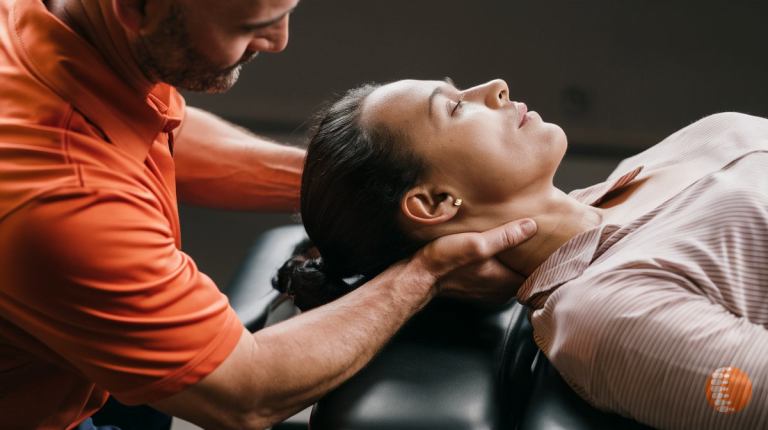
      Chiropractor manual therapy in winnipeg

      The muscles at the back of the neck, found deep to the trapezius, play a crucial role in neck movement and stability. These muscles range from small, diagonal fibers to larger muscles that originate in the upper thoracic spine and attach to the neck or base of the skull. Their primary function is to aid in extending the neck and head, with some muscles also contributing to neck rotation. When… Read More »Relieving Overworked Neck Muscles: Techniques, Symptoms, and Lifestyle Adjustments

      Self Myofascial Release of the Shoulder: Teres Major

        The teres major muscle is an important muscle that affects the shoulder and shoulder blade.  It originates near the inferior angle of the scapula (the bottom tip of the shoulder blade). It travels up through the armpit and attaches onto the humerus.  In the arm pit it runs right along side the latissimus dorsi muscle. Activities that use this muscle The teres major helps to adduct the arm, rotate the… Read More »Self Myofascial Release of the Shoulder: Teres Major

        How to relax the Temporalis Muscle

          The temporalis is the muscle that you feel  over your temples when you clench your teeth and as you chew. The muscle can be tender to touch and can refer to the upper teeth, over the eyebrow and on the side of the head and sometimes to the temporomandibular joint (TMJ). It is responsible for closing the jaw (when both contract), moving the jaw from side to side (when one… Read More »How to relax the Temporalis Muscle

          Self myofascial release of the massetter muscle

            The masseter muscle is located at the angle of your jaw. As you clench your jaw you can feel this muscle contract. it’s primary action is to close the jaw but  can also contribute to retracting (pulling the jaw backwards) the jaw. Pain can refer to the ear, TMJ, over the eye and into the upper and lower teeth. It can be involved in tension-like headaches, cervicogenic headaches, ear aches… Read More »Self myofascial release of the massetter muscle

            Self Myofascial Release of the Rotator Cuff – Infraspinatus

              About the infraspinatus The infraspinatus muscle is one of 4 muscles that make of the  rotator cuff muscles. It aids with external rotation of the shoulder (turning the front of the arm out to the side), horizontal abduction (moving the arm away from the body when the arm is out in front of you), and stabilizing the shoulder joint. The muscle can be aggravated by catching yourself falling down the… Read More »Self Myofascial Release of the Rotator Cuff – Infraspinatus

              Self Myofascial Releases of the Teres Minor Muscle (rotator cuff)

                RKC Plank

                The teres minor  muscle is one of 4 muscles that make of the  rotator cuff muscles. It aids in stabilizing the shoulder joint and externally rotating the shoulder outwards Often when this is a problem you will experience discomfort in the back of the shoulder. Reaching up and backwards can aggravate your symptoms.  This muscle can be aggravated during a motor vehicle accident while holding onto the steering wheel. This… Read More »Self Myofascial Releases of the Teres Minor Muscle (rotator cuff)